
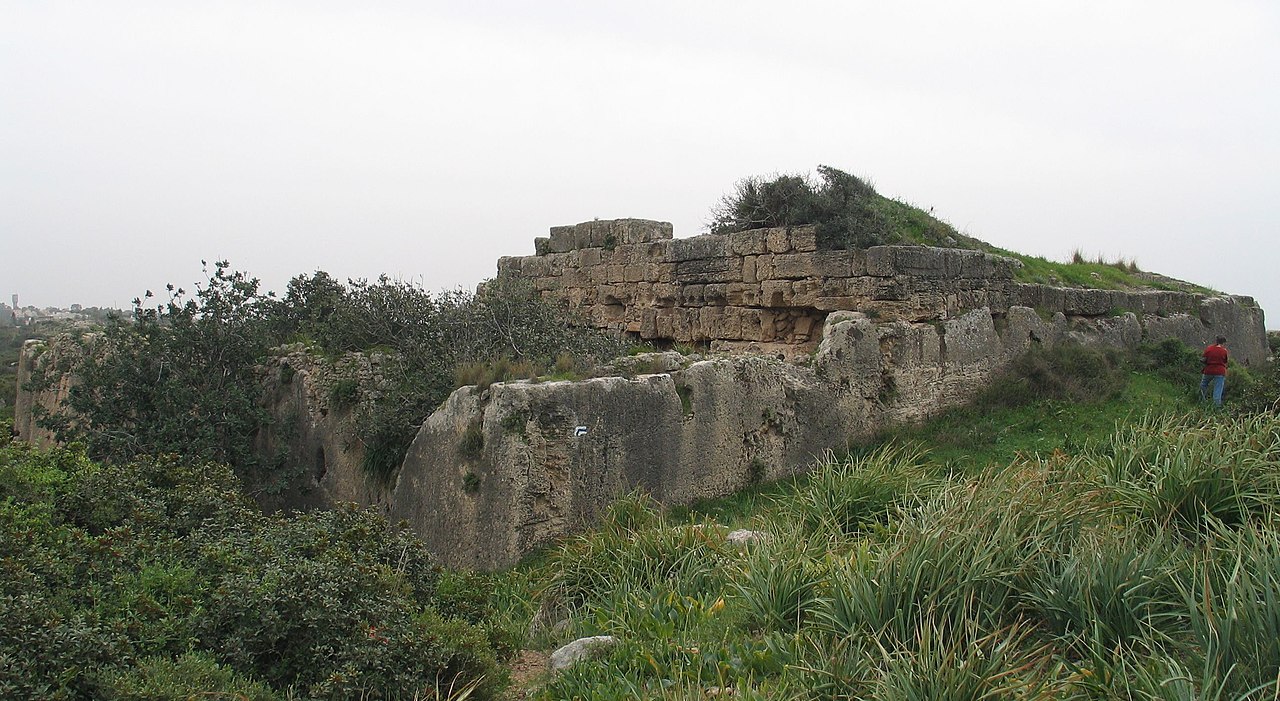
Castello in rovina · Atlit, Israele
Le Destroit
Archaeological site in Israel
Aiuta a completare questa scheda
0 su 5- Foto dei visitatori Nessun visitatore l'ha ancora fotografato: sii il primo e vinci il badge Pioniere Carica +22
- Orari di apertura Aggiungi +5
- Prezzi dei biglietti Aggiungi +5
- Come arrivare Aggiungi +5
- Aperto o chiuso? Visita recente Era aperto quando ci sei andato? Raccontacelo (se l'hai visitato)
Questa voce non è ancora disponibile in italiano. Mostriamo la versione inglese.

Le Destroit (for alternative names see below) is a ruined medieval fortified road station, built by the Templars of the Crusader Kingdom of Jerusalem in the early 12th century CE, located on the Mediterranean shore near a site where they later built the Chateau Pelerin castle, today close to the modern town of Atlit, Israel.
Names and etymology
The Frankish name of the fort was Casel Destreiz and le Destroit, with the Latin variants Destrictum and Petra Incisa. The Arabic name of the site is Khirbat Dustray (alternative spelling Khirbet Dustrey). The Hebrew name is Horvat Qarta.
The Frankish name is derived from Latin (districtus and distringere, consisting of the preposition de and the verb stringere, to tighten) via the Gallo-Romance languages, which retained the meaning of 'narrow' and 'restricted' referring to a connecting way or passage, which resulted in the meaning of 'strait'.
History
The coastal road near Atlit ran through a narrow passage in the rock, making it an ideal location for robbers to ambush pilgrims and other travelers. In 1103, Baldwin I of Jerusalem was wounded by robbers in the area. The tower fortress, which was situated on a ridge above the pass on the east side of the peninsula at Atlit, was built to protect these travelers.
The army led by King Richard I of England camped at the fortress following the recapture of Acre in 1191. However, when the larger Castrum Perigrinorum was completed in 1218, Le Destroit was dismantled by the Crusaders so that it couldn't be used by the Muslim enemy as a staging ground for an attack on the main castle. Denys Pringle indicates 1220 as the year Destroit was destroyed.
Current condition
Today the podium-shaped tower base with rock-cut cisterns, the rock-cut yard containing the stables, as well as the moat can still be seen. The remains are cut into the living rock, an aeolian quartz sandstone known in the region as kurkar.
Testo tratto dalla voce di Wikipedia Le Destroit, dei suoi autori, disponibile con licenza CC BY-SA 4.0.
Foto dei visitatori
Ancora nessuna foto. Hai visitato questo castello? Sii il primo!
Commenti
Ancora nessun commento.